That's an FTC Win: "Conflict U." Judge Issues Orders Asking Whether He Should Recuse in University-Involved Cases
By Gabe Roth and Manny Marotta
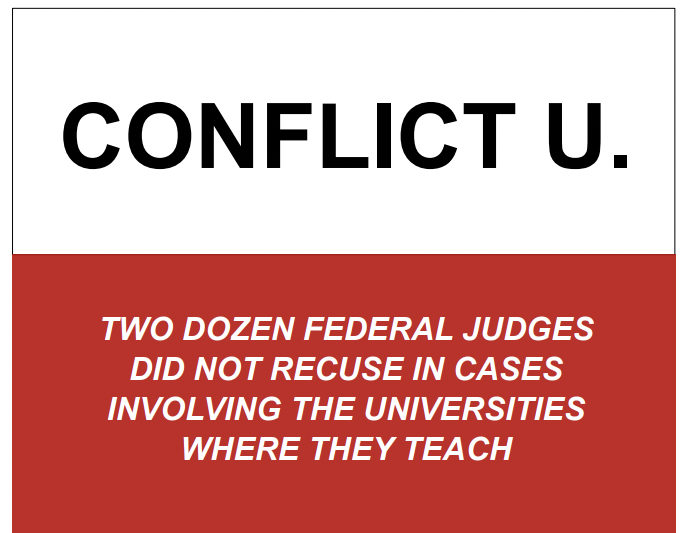 In July, Fix the Court published a report called “Conflict U.,” which identified 24 federal judges with part-time teaching jobs at law schools who failed to recuse in more than six dozen cases involving the schools’ parent universities.
One of the 24 was S.D. Ohio Judge Michael Watson, who teaches at Ohio State University’s Moritz College of Law.
Watson is not in the habit of recusing in cases involving Ohio State, though we believe he should be. (In addition to his teaching there, his wife owns a business that licenses OSU merchandise; she pays a 12 percent royalty to the school for every OSU-trademarked product she sells and thus makes money from her relationship with the school.)
We’re not alone in thinking that there’s a conflict here. Several plaintiffs in the Strauss litigation (cases that Watson is overseeing involving former OSU physician Richard Strauss, who abused hundreds of students during his 20-year tenure in the school’s athletics department) filed a recusal motion on Sept. 15, 2021.
Watson shortly thereafter denied the motion. Then on Feb. 15, 2023, the Sixth Circuit sided with him and blessed his continued participation in the Strauss cases.
More OSU cases assigned
Since the Sixth Circuit’s order came out, Watson has been assigned 12 cases involving OSU as a party. Six of those involved Strauss, and six didn’t.
Before we get to the latter six, let’s talk about another OSU case, Dehen v. OSU, assigned to Watson on Feb. 6, 2023.
A week after the Sixth Circuit ruling, Watson issued in Dehen what we’re calling a “maybe-conflict” order where he asked the parties to consider whether he should recuse given that he “teaches a trial practice class at the Moritz College of Law at OSU” and his “wife owns and operates The Flag Lady’s Flag Store, which has a licensing agreement with OSU.”
That was a small but significant step. Dehen asked for a recusal in March, mostly relying on the same grounds as the Garrett plaintiffs, and Watson denied her request in April for the same reasons he denied the Garrett request.
But then a long time passed before Watson realized he could have a conflict in OSU cases. The aforementioned “latter six” cases were assigned in Sept. 2023 (Sullivan v. OSU), Oct. 2023 (Jane Doe v. OSU), Nov. 2024 (Smith v. OSU Wexner Medical Center), another Nov. 2024 (Hill v. OSU), Mar. 2025 (St. John v. OSU) and Oct. 2025 (Phieffer v. OSU), and in each instance, Watson was assigned the case within a month of the initial filing (save St. John, where it was two months).
In four of these six cases — Sullivan, Doe, Smith and St. John — Watson didn’t file a “maybe-conflict” order, a la Dehen, until Oct. 3, 2025. What had happened between his assignments and that date? Fix the Court’s “Conflict U.” report came out.
(In the fifth, Hill, the plaintiff moved for Watson’s recusal right off the bat. And the sixth, Phieffer, was filed on Oct. 20, 2025, with Watson filing his “maybe-conflict” order on Oct. 24.)
We appreciate Watson’s renewed interest in appreciating his potential conflict, and we hope that he continues to offer this route to parties in future cases involving Ohio State.
The better course, of course, would be not to participate in these cases, but we’ll take the victories where we can.