The Justices Return to Capitol Hill After Seven Years Away
By Manny Marotta
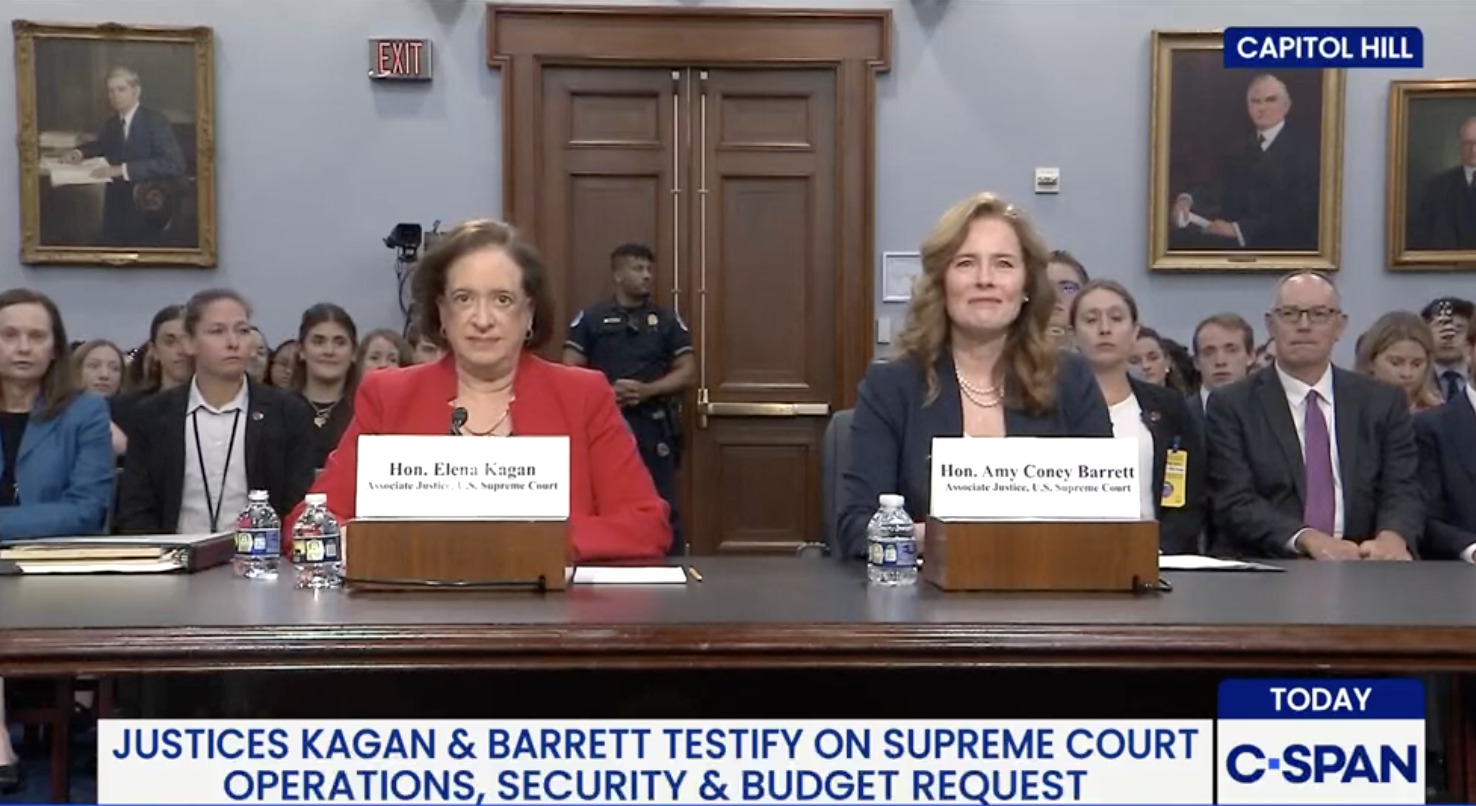 Seven years after the last time Supreme Court justices appeared before the House Financial Services and General Government Subcommittee to discuss the judiciary’s budget, Justices Elena Kagan and Amy Coney Barrett returned to that Subcommittee as the first part of a double feature, with an afternoon hearing in Senate FSGG to follow.
The House side
Though the House hearing largely focused on the Court’s urgent security needs — for which the Court deserves all the money it’s requested, assuming proper contracting oversight and employment protections — several members asked questions about ethics and transparency issues. (Click here to watch an affecting exchange on SCOTUS security.)
Ranking Member of the full Committee, Rep. Rosa DeLauro, pressed the justices on gifts, noting that members of Congress are subject to strict gift limits and oversight while the Supreme Court’s Code of Conduct remains self-enforcing.
Barrett responded to DeLauro that the justices follow the Judicial Conference’s gift restrictions, cannot accept gifts from litigants and must publicly disclose reportable gifts under the Ethics in Government Act. She added that when ethical questions arise, she consults the Court’s in-house counsel.
Kagan then addressed the enforcement issue plaguing the Court’s ethics regime. She acknowledged that the Court’s Code of Conduct contains “no enforceability system” and reiterated a view she originally expressed in 2024: that the Court should continue working toward an enforceable Code.
Meanwhile, she emphasized the institutional challenge of designing an enforcement mechanism that preserves judicial independence, saying that she would not want the Executive Branch or Congress deciding whether a justice violated ethical rules. Instead, she suggested any solution would have to originate within the judiciary itself. (Note: all enforceable ethics legislation introduced in Congress has involved only members of the judiciary conducting the oversight work.)
Kagan said that proposals such as enlisting respected retired judges have been discussed but said the Court has yet to decide on an approach.
The hearing also touched on the Court’s emergency-slash-shadow docket, which has increasingly attracted public attention. Responding to Rep. Mark Pocan, who questioned the dramatic increase in emergency applications in recent years, Barrett explained that unlike the Court’s merits docket, the justices cannot simply decline to consider emergency applications. Every request must be resolved, either by granting or denying relief, meaning that the Court lacks the discretion it exercises when deciding whether to hear appeals.
Kagan agreed that emergency proceedings have significant drawbacks because they often proceed without full briefing or oral argument. She suggested the Court’s own willingness to grant emergency relief in some cases has encouraged more litigants to seek it. At the same time, she said the justices in the last year or so have increasingly attempted to provide more process and context in significant emergency cases.
Finally, a new and interesting transparency question surfaced in the hearing: Rep. Sanford Bishop asked whether the Court would consider publicly disclosing contracts with outside vendors, particularly security contractors, worth more than $1 million annually. Kagan responded that neither she nor Barrett had previously considered the proposal and would need to examine it further before offering a position.
The Senate side
As on the House side, the hearing before Senate FSGG largely focused on the Court’s increased security needs, though senators also pressed the justices on ethics and transparency issues even more intensely than than their House peers.
The hearing’s most substantial exchange on those topics focused on the unresolved question of enforcement of the Court’s Code of Conduct. Sen. Jack Reed asked whether the Court was working toward an effective enforcement mechanism for its ethics code, calling the idea of an enforcement mechanism “more aspirational than real.”
Barrett rejected the “aspirational” language and asserted that all nine justices consider themselves bound by the Code, and that she, personally, relies on the Court’s legal counsel when ethical questions arise.
Barrett nevertheless acknowledged that designing an enforcement system has proven difficult because any mechanism must preserve judicial independence and avoid placing either the Executive Branch or lower federal courts in a supervisory role over the Supreme Court. While ideas such as using senior or retired judges have been discussed, Barrett said the Court has not yet found a workable solution.
Kagan went a step further in addressing institutional challenges, saying that she has “come to rest on the need for an enforcement mechanism,” provided that it is created within the judiciary. She said such a system would not only reinforce public confidence in the Court but also provide a means of dispelling unfounded allegations of misconduct. Although she acknowledged the structural awkwardness of having lower-court judges review Supreme Court justices, she expressed confidence that the Court could develop an appropriate solution.
Sen. Chris Coons turned to financial disclosure compliance, asking whether additional penalties or legislative changes were needed to improve compliance with existing disclosure deadlines. Coons noted that although all of the justices’ disclosures were posted on time in the online database created as a result of a bill that he and Sen. John Cornyn wrote in 2022, the vast majority of lower court judges’ disclosures are not posted by the mid-August deadline each year.
Justice Kagan declined to comment on the impacts of the legislation but emphasized that “every judge should be in compliance” with disclosure rules.
Van Hollen also asked whether the Court’s ethics rules prohibit justices or Court employees from using nonpublic information to trade on prediction markets. Both Kagan and Barrett responded affirmatively: Barrett said existing ethics rules already prohibit using confidential Court information for financial gain, and Kagan said that the prohibition applies to all Court employees, not only justices.
She nevertheless welcomed Van Hollen’s suggestion that the Court review its rules for any potential loopholes, calling the issue “super important.” (Read Van Hollen’s follow-up letter to the Court here.)
As in the House hearing, senators also questioned the justices about the Court’s increasingly active shadow docket. Responding to Sen. Patty Murray, Kagan said that the Court has been receiving far more requests for emergency relief in recent years and acknowledged that the justices continue debating both the standards governing those requests and the amount of process that each request should receive. She said the Court has become more willing to require additional briefing, oral argument and fuller explanations in significant emergency cases but acknowledged that “we can still improve what we’re doing.”
Barrett similarly described the emergency docket as a work in progress, explaining that unlike the Court’s merits docket, emergency applications vary considerably and do not lend themselves to a one-size-fits-all process. The justices, she said, are continuing to determine which emergency matters warrant more extensive procedures and fuller explanations and which can appropriately be resolved through summary orders.
Van Hollen later pressed both justices on whether increased use of the emergency docket has itself encouraged more litigants to seek emergency relief and asked what precedential weight lower courts should give emergency decisions. Kagan acknowledged that the Court’s own precedents provide mixed guidance on the precedential effect of emergency rulings and agreed that precedent remains an important issue. She also emphasized a point that she made in the House earlier in the day: because litigants have seen the Court grant emergency relief in some cases, more attorneys now view emergency applications as a routine part of litigation. That, she suggested, has contributed to the dramatic increase in emergency filings since she joined the Court 16 years ago.
Overall, the hearings provided the justices a chance to explain the Court’s position on issues related to ethics, transparency and the shadow docket, among other issues, and it’s our hope that there will not be another seven-year gap before the justices testify before Congress again.